


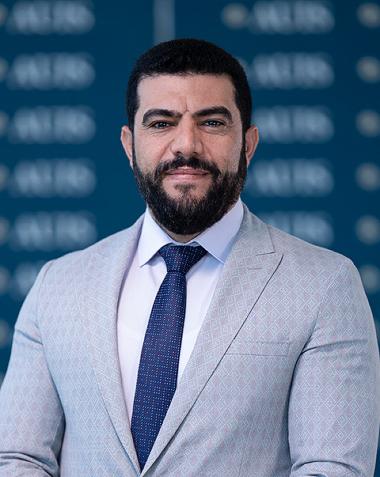
Mohanad Nada
Associate Professor of Hematology & Pathology Chairman of Medical & Health Sciences DepartmentDepartment of Medical & Health Sciences (MHS)
- Clinical Fellowship: University Medical Center in Utrecht, the Netherlands
Postdoctoral Fellowship: University of Iowa Hospital & Clinics, U.S.A.
Ph.D. from Carver College of Medicine, University of Iowa, U.S.A.
C.P.H. from College of Public Health, University of Iowa, U.S. A. - Email: [email protected]
- Office: B-F1-13
Profile
Dr. Mohanad Nada, affectionately known as Dr. Mo, is a medical hematologist specializing in hematologic disorders, hematopoietic stem cell (bone marrow) transplantation, and cancer immunotherapy. He has completed advanced clinical and research training at internationally leading medical institutions in the United States and Europe, establishing expertise in hematology, transplant medicine, immunology, and pathology.
Dr. Mo completed his medical education and training for the doctoral and postdoctoral levels at the Carver College of Medicine, University of Iowa, where he also completed a Graduate Diploma in Public Health with a focus on cancer prevention. Prior to joining the American University of Iraq, Sulaimani (AUIS), he completed a postdoctoral fellowship in the Department of Internal Medicine at the University of Iowa Hospitals & Clinics (UIHC), conducting translational research in cancer immunology and immunotherapy.
With more than a decade of experience in medical education, clinical training, translational research, and academic leadership, Dr. Mo has taught and mentored students in both the United States and Iraq. Most recently, he completed an intensive clinical fellowship in Hematopoietic Cell Transplantation at University Medical Center Utrecht (UMC Utrecht), the Netherlands. The fellowship, funded by the American Society of Hematology (ASH), focused on advanced bone marrow transplantation, transplant immunology, and the development of transplant programs in resource-limited settings.
Dr. Mo is an active member of several leading international professional organizations, including the American Society of Hematology (ASH), European Society for Medical Oncology (ESMO), American Association for Cancer Research (AACR), American Association of Immunologists (AAI), and the Society for Immunotherapy of Cancer (SITC). Through these affiliations, he remains actively engaged in advancing research, education, and international collaboration in hematology and oncology.
His scientific contributions have been recognized through numerous national and international awards, including the American Society of Hematology (ASH) Award (2025), the ESMO Merit Award (2022) presented at the ESMO Congress in Amsterdam, and the Munich Cancer Center Award (2019) presented at the International Translational Oncology Conference (ITOC-06) in Vienna. Nationally, he has been the receipt of one of the country's highest national medical awards in recognition of his contributions to medical education, research, and healthcare development.
Dr. Mo maintains active research collaborations with leading institutions across the United States and Europe. His research focuses on tumor immunology, cancer immunotherapy, hematopoietic stem cell transplantation, and translational medicine, with the goal of developing innovative immune-based therapies for cancer and blood disorders. His work has been published in high-impact international peer-reviewed journals and presented at major scientific conferences worldwide.
Beyond research and clinical practice, Dr. Mo is committed to strengthening healthcare capacity in Iraq by advancing medical education, developing specialized clinical services, and establishing international collaborations in hematology and bone marrow transplantation. He welcomes opportunities to collaborate with physicians, scientists, and institutions that share a commitment to improving patient care and advancing biomedical research.

Publications
- A, S., Hameed, M., Azeez, S., Omer, S., Ameen, K., A, T. and Nada, MH., 2025. Challenges in student assessment in medical and health sciences education in Northern Iraq. BMC Medical Education, 25(1), p.1052.
- Nada MH, Wang H, Hussein A, Tanaka Y, and Morita CT. PD-1 checkpoint blockade enhances adoptive immunotherapy by human Vγ2Vδ2 T cells against human prostate cancer. OncoImmunology, 10:1 (2021)
- Wang H, Nada MH, Sakuraba S, Tanaka Y, Morita CT. Critical roles for coiled-coil dimers of butyrophilin 3A1 in the sensing of prenyl pyrophosphates by human Vγ2Vδ2 T cells. J Immunol 2019
- Nada MH, Wang H, Workalemahu G, Morita CT. Enhancing Adoptive Cancer Immunotherapy with Vγ2Vδ2 T Cells through Pulse Zoledronate Stimulation. Journal for ImmunoTherapy of Cancer 5.1 (2017): 9. (IF:13.75)
- Tanaka Y, Murata K, Iwasaki M, Matsumoto K, Hayashi K, Kumagai A, Nada MH, Wang H, Kobayashi H, Kamitakahara H, Okamura H. Expansion of human γδ T cells for adoptive immunotherapy using a bisphosphonate prodrug. Cancer Science. 2017 Dec.
- Workalemahu G, Wang H, Nada MH, Puan K-J, Kuzuyama T, Jones BD, Jin C, Morita CT. Metabolic engineering of Salmonella vaccine bacteria to boost human V2V2 T cell immunity. Journal of Immunology 2014; 193:708.
- Nada, MH, Almolla Ihsan. Prognostic value of IL-6 in breast cancer patients. Tikrit Medical Journal (2010);17-23
- Nada MH, Wang H, Morita CT. Optimizing adoptive cancer immunotherapy with gamma delta T cells. Workshop and poster presentation at the Autumn Immunology Conference, Chicago, IL, (November 2012).
- Nada MH, Wang H, Morita CT. Optimizing Cancer Immunotherapy with T cells: the role of IL-15. Workshop and poster presentation at the Autumn Immunology Conference, Chicago, IL, (November 2013).
- Nada MH, Wang H, Workalemahu G, Morita CT. Optimizing adoptive cancer immunotherapy with T cells through “pulse” zoledronate stimulation and IL-15. Poster presentation at the American Association of Immunologists Annual Meeting, Pittsburg, PA, (May 2014).
- Workalemahu G, Wang H, Puan K-J, Nada MH, Kuzuyama T, Jones, BD, Morita CT. Metabolic engineering of Salmonella vaccine bacteria to boost human T cell immunity. Abstract. Poster presentation at the 2014 T Cell Conference, Chicago, IL, (May 2014).
- Nada MH, Wang H, Workalemahu G, Morita CT. Optimizing adoptive cancer immunotherapy with V2V2 T cells through Zoledronate pulse stimulation and IL-15. Plenary presentation at the 6th International 2014 T Cell Conference, (May 2014).
- Nada MH, Wang H, Workalemahu G, Tanaka Y, Morita CT. Optimizing adoptive cancer immunotherapy with γδ T cells through pulse zoledronate stimulation. Poster presentation at the 2016 γδ T Cell Conference, London, U.K., (June 2016).
- Morita CT, Wang H, Workalemahu G, Tanaka Y, Nada MH. Enhancing adoptive cancer immunotherapy with γδ T cells through pulse zoledronate stimulation. Federation of Clinical Immunology Societies Annual Meeting, (June 2017)
- Nada MH, Wang H, Morita CT. PD-1 checkpoint blockade therapy enhances adoptive immunotherapy by human Vγ2Vδ2 T cells against prostrate tumors in a preclinical model. AAI annual conference, Austin, TX, (May 2018).
- Nada MH, Hussein A, Wang H, Morita CT. PD-1 checkpoint blockade therapy enhances adoptive immunotherapy by human Vγ2Vδ2 T cells against prostrate tumors. European Journal of Cancer 110 (2019), S23
- Morita CT, Nada MH, Workalemahu G, Wang H, Attenuated Listeria vaccine for cancer immunotherapy expands Vγ2Vδ2 T cells in rhesus monkeys that retain their central memory phenotype and HMBPP responsiveness. The Journal of Immunology 202 (1_Supplement) (June 2019), 138.16-138.16
- Nada MH, Hussein A, Wang H, Morita CT. IL18 improves the anti-cancer immunity of human Vγ2Vδ2 T cells against prostrate tumors. Annals of Oncology 31 (March, 2020), S3-S4
- Nada MH, Hussein A, Wang H, Morita CT. he efficacy of combining adoptive immunotherapy by human Vγ2Vδ2 T cells and PD-1 checkpoint blockade against human. European Society of Medical Oncology (ESMO)- Annals of Oncology 33, (October, 2022), S1409

