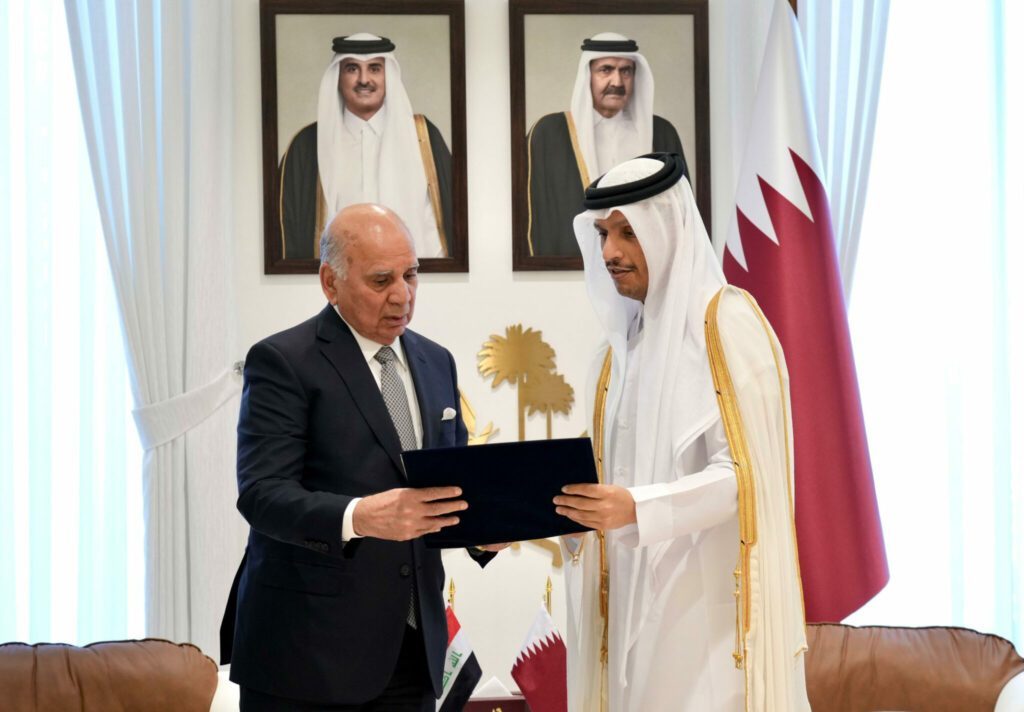
Source of Photos: Ministry of Foreign Affairs, The Republic of Iraq
Among GCC states, Qatar has emerged as Iraq’s most active economic partner, committing more than $9 billion since 2023 across energy, logistics, infrastructure, and real estate [1]. Its investments include participation in the Gas Growth Integrated Project, expanded cargo operations through Milaha, and support for the Development Road Project [2]. No other GCC state has matched the breadth of Qatar’s engagement. Qatar’s engagement offers a way to think about what Iraq–GCC integration can realistically look like.
It suggests that integration need not run through GCC membership or a single institutional framework, and that bilateral investment canbuild meaningful economic linkages. Qatar’s relationship with Baghdad rests on conditions other Gulf states do not share, so it cannot be copied as a template. However, it still offers a lesson. No two Gulf states will engage Iraq for the same reasons or through the same channels, yet none can afford to ignore a market of Iraq’s scale and consumer base, and in every case the decisive factor is whether Baghdad can provide the governance and operating environment to turn investment into lasting transformation.
Qatar-Iraq engagement has been tested by the wider regional war and the closure of the Strait of Hormuz. Qatar is among the most exposed states in the Gulf to these disruptions. Almost all of its liquefied natural gas, the source of the wealth it has been deploying abroad, must transit the Strait, and Doha has no pipeline bypass of the kind Saudi Arabia and the UAE rely on for their oil. The disruption reaches the revenue base that funds Qatar's investments in Iraq, and it poses two questions that run through what follows. The first is whether a relationship built so heavily on Qatari capital can withstand a shock to the source of that capital. The second is whether the same disruption makes Iraq more attractive to Doha, or less.
The Strategic Logic on Both Sides
Qatar’s engagement with Iraq is not primarily driven by proximity or shared history, but by a broader strategy of economic statecraft that uses investment and commercial ties to build influence and mitigate the vulnerabilities of a small state operating in a volatile regional environment. Qatar’s position in the Gulf has long encouraged it to cultivate networks of economic interdependence that reduce its strategic vulnerabilities, particularly following the 2017–2021 Gulf crisis [3]. Iraq fits this approach well. By investing in Iraq’s energy, reconstruction, and logistics sectors, Doha gains not only economic returns but also a long-term stake in Iraqi stability and influence within the country’s evolving economic architecture.
Doha’s ability to build strong relations with Baghdad beyond (or regardless of) the GCC’s priorities with Iraq derive in part from Qatar’s relationship with Iran. Qatari political analyst and media personnel Abdulaziz Al-Ishaq states that despite periods of “regional tension between Iran and other Arab states (particularly the GCC)”, relations between Baghdad and Doha have remained relatively stable – regardless of the implications of Iraq-GCC relations from Iranian political influence in Iraq. This resilience stems partly from “Qatar’s policy of avoiding direct confrontation with Iran,” which has limited the extent to which Iranian influence in Iraq has hindered the development of bilateral ties [4]. This assessment reconciles with previous interpretations of the Qatari engagement with Iraq over the years being much more “immune” to Iranian influence in Iraq, unlike its Saudi counterpart [5].
Iraq’s Ambassador to Qatar, H.E. Mr. Mohamed Jafar Al-Sadr, argues that the ‘Qatari model’ demonstrates how institutional cooperation can strengthen Iraq–GCC relations, and that expanding this approach across GCC states could deepen regional economic integration and transform bilateral ties into strategic partnerships. “Growing Gulf, particularly Qatari, investment in Iraq highlights the model’s potential to overcome structural challenges when supported by political commitment and effective implementation.[6]” The potential for deepening Gulf investment in Iraq, alongside the emerging pattern of GCC member states independently pursuing bilateral ties with Baghdad, points to a significant recalibration of Gulf foreign policy — one that transcends the historically "sect-centric" paradigm that long constrained relations between the Gulf and Iraq post-2003 [7].
Growing Gulf, particularly Qatari, investment in Iraq highlights the model’s potential to overcome structural challenges when supported by political commitment and effective implementation.
Iraqi policymakers should recognize these geopolitical dimensions of Qatar’s engagement. By becoming integral to Iraq’s economic revival, Qatar reduces Iraq’s dependence on its immediate neighbors while reinforcing its own regional influence and relevance to Washington, which remains invested in Iraqi stability. For Doha, the relationship is not merely bilateral but part of a broader diplomatic strategy.
Iraq’s incentives are equally concrete, and they begin with a structural economic vulnerability that no Iraqi policymaker can afford to ignore. Oil revenues account for more than 91 percent of Iraqi export earnings, approximately 88 percent of the government budget, and roughly 53 percent of GDP [8]. The IMF’s 2020 Article IV review of Iraq projects widening fiscal deficits and rising debt-to-GDP ratios through the mid-2020s, driven in large part by oil price volatility and an absence of economic diversification [9]. Against this backdrop, Qatari capital can be seen as patient, politically sophisticated, and familiar with the region’s operating environment in a way that Western or Asian investors are not, and that represents a qualitatively different kind of partnership.
Qatar’s engagement is significant not only as a source of capital but also for its sectoral impact. Investment in the Gas Growth Integrated Project supports technology transfer and capacity-building, while Milaha’s operations at Umm Qasr strengthen Iraq’s trade links with GCC and international markets. The Development Road MoU with Turkey and the UAE could generate up to $4 billion annually at full capacity, helping reduce Iraq’s dependence on oil exports and deepen its integration into regional supply chains [10].
| Investment amount | Details | Project |
|---|---|---|
| 25% of $27bn = $6.75 billion | Qatar owns a 25% stake in TotalEnergies' $27 billion integrated energy project in Iraq. Iraq's Basra Oil Company holds 30%, while TotalEnergies retains the remaining 45% [11]. | Gas Growth Integrated Project |
| Included in the $27bn | Energy production of 1.25 gigawatt; serves 350,000 households; completion between 2025–2027. | Solar Energy Project in Basra Governorate |
| 50% stake in the solar power component of the TotalEnergies project | QatarEnergy has also secured a 50% stake in the solar power component of the TotalEnergies project [12]. | |
| $5bn (promised) | Promised and committed investment from Qatar to invest in Iraq through various channels. | Overall committed investments |
Table: List of Qatari investments in Iraq. [13]
A few clarifications on the table above: Qatar's 25% stake in TotalEnergies' $27 billion energy project is not included in the $9 billion figure, which covers only Doha's direct investment in new projects — the TotalEnergies stake will likely be added once its returns become clearer. QatarEnergy's 50% stake in the project's solar component is excluded for the same reason, and may have been an unintended byproduct of Iraq's push to diversify away from Iranian energy imports. The separately promised $5 billion remains pending, though publicly confirmed by the Iraqi Embassy in Doha.
The institutional architecture sustaining this engagement has also deepened. The seventh session of the Qatari-Iraqi Joint Committee for Economic and Trade Cooperation, convened in Baghdad on July 7–9, 2024 and co-chaired by both countries’ trade ministers, focused on investment opportunities across industry, infrastructure, renewable energy, digital transformation, and financial services. Qatar Chamber has initiated discussions with the Federation of Iraqi Chambers of Commerce on establishing a joint business council and a Qatari-Iraqi Business Forum, signaling that the relationship is beginning to move below the state-to-state level, where durable economic ties are ultimately built.
Risks and Limiting Conditions
An honest appraisal of the Qatar–Iraq relationship must reckon with the risks that complicate it, and these are risks that Iraqi policymakers bear primary responsibility for addressing. The most immediate challenge is the “militia economy.” Iran-aligned armed factions hold economic interests in sectors attractive to Gulf investors, including reconstruction, border logistics, and real estate. As a result, Qatari investment risks becoming entangled in factional competition or facing pressure from armed actors that view Gulf capital as a resource to be captured. However, foreign and Gulf investors have rarely been directly targeted, despite extensive militia-linked criminality [14].
Doha’s response has been deliberate. Qatar has relied on formal state channels, including joint committees, investment agreements, and MoUs, rather than informal networks. This serves as both risk management and a political signal: investment depends on Iraq’s ability to provide a predictable and secure environment. For Iraqi policymakers, this conditionality is not an obstacle but an incentive to strengthen state institutions and attract broader Gulf engagement. Mr. Al-Ishaq rejects the notion that Qatar seeks to draw Iraq into a specific geopolitical alignment, stressing instead that “Qatar has maintained constructive relations with a wide spectrum of Iraqi political actors. [15]”By engaging a wide range of political actors, Doha has gained an advantage (in contrast to its neighbors) in accessing Iraq’s economic and investment opportunities.
Qatar has maintained constructive relations with a wide spectrum of Iraqi political actors.
According to Dr. Seloom, Qatar’s engagement in Iraq follows a selective model focused on large-scale energy and infrastructure projects. Its resilience stems from structured investments, international partnerships, and relatively secure operating environments rather than state-to-state channels alone. While effective for major projects, the model has limited reach into Iraq’s wider private sector, resulting in a footprint that is deep but narrow [16]. The IMF’s Article IV review similarly argued that reforms in labor markets, the financial sector, anti-corruption, and state capacity are essential for turning investment pledges into lasting economic gains. Without them, Gulf capital risks reinforcing patronage networks rather than productive investment. The main constraint is not only Gulf willingness, but Iraq’s absorptive capacity.
A further risk concerns the Kurdistan Region of Iraq (KRI), which remains largely excluded from the Development Road framework [17]. This could narrow the project’s economic base and create political friction between Erbil and Baghdad. If the Development Road is to serve as a genuinely integrating infrastructure project, the KRI’s position must be resolved. The most significant risk to the relationship is the wider regional conflict centered on Iran. Because Iraq hosts both Iran-aligned armed groups and U.S. forces, it remains vulnerable to proxy escalation and spillover violence. Sustained conflict could disrupt the air, port, and transport infrastructure targeted by Gulf investment and trigger instability in oil markets, on which Iraq’s fiscal position heavily depends.
For Qatar, the exposure is more direct than for any other Gulf investor. Almost all of Qatar’s liquefied natural gas exports, the foundation of the wealth it has been deploying across the region, must pass through the Strait of Hormuz, and unlike Saudi Arabia and the UAE, Doha has no pipeline route that bypasses the chokepoint. The closure of the Strait and the damage to Gulf energy infrastructure during the current war therefore strike at the revenue base that funds Qatar’s overseas investment, narrowing the fiscal space from which its commitments to Iraq are made. This poses a direct question for Baghdad, of whether Qatari investment in Iraq is insulated from such a shock or among the first commitments to be deferred when Doha’s own income is squeezed. Qatar’s careful balancing of relations with Washington, Tehran, and its Gulf neighbors would also narrow under a prolonged conflict, reducing the diplomatic space on which its Iraq strategy depends.
Yet the same disruption cuts the other way. A chokepoint that can be closed at will is precisely the vulnerability that makes diversification attractive, and Iraq offers Qatar exposure to energy, logistics, and overland routes that do not depend on Hormuz. The Development Road, which Doha backs, is in part a wager on corridors running north through Turkey rather than south through the Gulf. On this logic, a sustained threat to Hormuz could make Qatar’s Iraqi investments more strategically valuable rather than less, provided the war does not also render Iraq itself too unstable to operate in. Whether Doha reads the moment as a reason to retrench or to deepen its position is one of the central uncertainties now hanging over the relationship.
According to Mr. Al-Ishaq, Qatar’s foreign policy is defined by its role as a neutral mediator able to engage competing actors, a position it has maintained even during periods of tension with Iran. The sustainability of this approach rests on Qatar’s preference for avoiding rigid alignments and on the shared interest of regional and international actors, including Iran and the United States, in preserving Doha as a credible intermediary [18]. This interpretation aligns with how Qatar has long navigated a delicate balance between Washington and Tehran, avoiding alignment with either side while leveraging its position as a diplomatic intermediary to facilitate backchannel communication between the two powers in pursuit of de-escalation [19].
A prolonged regional conflict would strengthen Iran-aligned factions in Iraq, deepen the militia economy, and raise the cost of investment in key infrastructure and energy projects. For initiatives such as the Development Road and the Gas Growth Integrated Project, sustained instability could increase security risks and encourage a more cautious Gulf investment approach. The durability of Qatar-Iraq cooperation may therefore depend on insulating economic ties from regional instability.
Implications for Iraq–GCC Integration
What does the Qatar relationship tell us about the prospects for Iraq’s broader economic integration with the Gulf? The honest answer is encouraging but conditional. Qatar’s case is in part specific to Qatar. Its ability to work across Iraq’s factional lines owes much to its non-confrontational posture toward Iran, and Seloom’s account of a footprint that is deep but narrow shows how far the model is built around large energy and infrastructure projects rather than the wider economy. Those conditions will not reproduce elsewhere, and no two Gulf states will engage Iraq for the same reasons or through the same channels. What Qatar offers, then, is a demonstration rather than a blueprint. None of the Gulf states can afford to ignore a market of Iraq’s scale and consumer base, and Qatar shows that self-interested bilateral engagement, pursued on each state’s own terms, can still accumulate into real economic integration, provided Baghdad supplies the governance to sustain it.
Integration does not require GCC membership or a single institutional framework. Given Iraq’s ties to Iran, the United States, and Turkey, any integration model must accommodate Baghdad’s sovereignty concerns and multiple alignments. The Qatar model shows this is possible. Bilateral investment, the Development Road, and private-sector engagement can generate the economic linkages usually associated with formal integration. Together, Saudi electricity interconnection projects, UAE involvement in Grand Faw Port, and Qatar’s multi-sector investments are already creating a de facto integration that is reshaping Iraq’s economic geography.
The durability of this integration ultimately depends on decisions made in Baghdad. GCC states engage Iraq because they see economic and strategic value, but this will endure only if Iraq improves governance, protects investment from the militia economy, reduces business costs, and delivers on key infrastructure commitments. In this regard, the ongoing disarmament campaign is a positive signal of the state’s effort to strengthen control over the economy and reflects growing political and societal resistance to continued militant influence, despite concerns over the process itself.
Beyond the existing economic relations, potential industries or markets in Iraq that could be of Qatar’s economic interest include, but are not limited to: renewable energy; digital economy and technological infrastructure; education, research, and career development; and reconstruction and infrastructure [20]. From Baghdad’s perspective, the concentration of Gulf interest is a rare strategic asset. Qatar’s $9 billion commitment [excluding Qatar’s stakes in the TotalEnergies’ project], the UAE’s involvement in Grand Faw Port, Saudi electricity interconnection projects, and the Development Road MoU reflect unprecedented confidence in Iraq’s economic future. Yet this confidence is not unconditional. The key question is not only whether the Gulf is willing to engage, but whether Iraq can provide the governance and operating environment needed to turn investment pledges into lasting economic transformation.
Qatar’s experience suggests the pathway is open. Whether Iraq walks it is a decision that rests with Baghdad, and on whether it can turn a rare moment of Gulf interest into the governance and operating environment that lasting investment requires.
This article will be included in the fourteenth edition of the Iraq Economic Review.