
Introduction
After years of hesitation and disruption following Iraq’s invasion of Kuwait and the subsequent removal of Iraq’s observer status from the Gulf Cooperation Council (GCC),1 the last decade has witnessed slowly growing Iraq-GCC integration. While this growth is marked by official transnational agreements, Memoranda of Understanding (MoU), and investment commitments, it represents only a part of the picture.2 Integration of this kind rests both on formal agreements between governments, and on the everyday commercial relationships that connect Iraqi businesses to GCC logistics and distribution networks. With the current conflict, beginning on the 28th of February with a US-Israeli attack on Iran,3 and the subsequent closure of the Strait of Hormuz, both layers of this integration have been placed under strain. While the disruption is usually analyzed through the security or oil sectors, what I explore here is the grassroots trade economy that is too often overlooked as an integral segment of economic integration. By grassroots, I mean the everyday commercial activity of individual traders and wholesalers who move goods through established routes and credit relationships, beneath the level of formal agreements between states. I approach these dynamics through the specific case of Iraq-UAE trade, which offers a lens onto a broader evolution in Iraq-GCC relations.
These commercial relationships are easy to overlook because they sit beneath the level of formal diplomacy, and they are harder to restore once disrupted. Where energy markets are buttressed by states and long-term contracts, grassroots trade depends on cost predictability and credit built up over time. From this economic perspective, I explore potentially overlooked sectors that – while not as dominant as energy4 or security – may actually be harder to restore as they lack the formal backing and foundation of Iraq-GCC economic integration.5 Specifically, and to highlight this grassroots integration, I explore the disruptions to the manufacturing and production sector that relies on grassroots traders importing construction materials from East Asia to the UAE and then to Iraq. I underscore the effects of the closure of the Strait and take a deeper look into the example of Iraq-UAE trade disruptions that could be harming Baghdad’s approach to greater GCC economic integration.
Ultimately, from Baghdad’s point of view, disruption and reconfiguration of GCC trade corridors possess important implications for its regional economic integration approach. Iraqi businesses typically utilize the UAE’s Jebel Ali Port located on the Gulf, viewed by Iraqi traders within the regional trade economy as a safe and predictable route. UAE’s Jebel Ali Port is ideally placed en route from China, Thailand, and Singapore to Iraq that are typically utilized to import construction materials (pipes, fittings, etc.). However, even with the April 7 ceasefire,6 the closure of the Strait continues to shift attention to alternate routes, such as the UAE’s eastern port on the Gulf of Oman that leads to the Arabian Sea and then the Indian Ocean, or more consequently alternate suppliers altogether, such as Türkiye. Iraqi businesses have few other options.
The erosion of Iraq-GCC trade in overlooked sectors such as manufacturing is a meaningful, but underappreciated consequence of this crisis.
With Türkiye available, both as a manufacturer and more predictable trade route, traders have positioned themselves as engaging in a waiting game, with their patience running out in trying to maintain their East Asia-UAE-Iraq trade route. As Saloom suggests, “The GCC is not the only actor shaping Iraq’s external options. Turkey, already Iraq’s largest non-oil trading partner and the anchor of the Development Road corridor, will fill this space.”7 The war and its aftermath are eroding some of the Iraq-GCC integration in ways many perhaps do not think about, particularly at the grassroots level. Speaking to traders on the ground that engage in this economy, as well as corporate stakeholders, I argue that the erosion of Iraq-GCC trade in overlooked sectors such as manufacturing is a meaningful but underappreciated consequence of this crisis and could consequently undo some of Iraq’s recent approach to GCC economic integration.
The limits of formal integration
The informally dominated Iraqi political sphere complicates any sort of growing Iraq-UAE (or GCC) integration.8 This is highlighted in the way UAE and Iraq have signed various agreements to protect mutual investments from an Iraqi political context that is unpredictable.9 These form a wider UAE strategy to shift its dependence away from the US, and practice some form of political hedging, building stronger regional ties with, for example, Syria even before the fall of the Assad regime.10 Notably, however, this protective approach is designed to allow the strengthening of trade ties to protect both countries’ investments from non-commercial risk, such as nationalization, confiscation, judicial seizures, and freezing.11 The UAE's strategy and fears are understandable, as the changing internal dynamics within Iraq are neither fully controlled by the formal state institution nor centralized under any single faction.12 Economic integration with Iraq is a complex interplay of numerous actors and renders state policy as one part of the picture.
Iraqi policy is itself fragmented, which raises the question of what is operationally possible in terms of GCC-Iraq integration, economic or otherwise. It perhaps explains why integration has been pursued more through economy than diplomacy. However, even this economic integration, which carries an informal component at the grassroots level that I explore below, is facing serious challenges with the closure of the Strait. High-level policy commitment, while important, does little to address the practical realities that traders and manufacturers currently face. Baghdad’s desire to align with the GCC depends not only on agreements between governments, but on whether the ordinary commercial relationships beneath them can be sustained.
Wartime Iraq-UAE trade
In my assessment of Iraq-UAE trade, one of two changes appears to be brewing. Some traders have found themselves fed up with the constant disruptions, either from the current war or from the political turmoil in Iraq, and see the closure of the Strait of Hormuz as the final straw. With the Houthis also threatening to close Bab al-Mandab,13 traders have begun exploring alternative options to the use of the East Asia-UAE-Iraq corridor. Traders have underscored the viability of Türkiye as a solution to the closure of the Strait, due to both its spatial proximity and its ability to provide the goods needed to maintain certain trades. Construction materials reach Iraq by sea from East Asia, transiting the Strait of Hormuz into the Gulf to the UAE’s Jebel Ali Port, before moving onward into Iraq. The closure of the Strait severs this sea leg, which is why routing through Khorfakkan, Sharjah (which is located in the middle of Emirate if Fujairah, and oftentimes referred to as the Fujairah port despite being in Sharjah), on the Indian Ocean side of the chokepoint, has become the principal workaround.
Prior to the war, the cost predictability of this route enabled traders in low-margin sectors to operate.
The location of the UAE, and especially, the advanced technology and infrastructure of its Jebel Ali Port, makes it a primary hub for transshipment. With its limited operations due to the closure of the Strait, in my research I found traders’ complaints of cost spikes due to rerouted maritime traffic to be industry-specific. Speaking to traders it was clear that particular changes were occurring to the trade of construction materials and plastic fittings along the trade route from East Asia to the UAE, and onwards to Iraq. Those working with high-value goods such as electronics (e.g. phones, gaming consoles, etc.) are facing little disruption to their work as they can simply transfer the raised costs to the consumer. Meanwhile, traders of construction materials that import from China and Thailand, and to a lesser extent Singapore, are at a crossroads as the spike in price cannot justify continuing to use the Gulf as a port of entry. Prior to the war, the cost predictability of this route enabled traders in low-margin sectors to operate.
This occurs as the rise in the price of oil has generated a trade system that faces a blow to its main source of movement. In speaking to Iraqi traders based in Iraq and the UAE, I found that some were more concerned with the closure than others. Traders in high-value goods typically import shipping containers that are worth nearly $500,000. As one trader explained, “my containers that I would import from China or Singapore used to cost me $3000, and now they cost around $12,000, but this is not a big issue for me. I simply have to add a small markup of around $6-8 to each one of my gaming consoles or products and I’ll be fine.”14 This trader was not simply suggesting that this change would keep him afloat but would even keep him profitable within what is considered an unprecedented crisis. Meanwhile, those importing low-value goods (such as pipes, fittings, sanitary products, furniture – these are among the traders I have spoken to, but presumably other sectors are similarly influenced) have all bemoaned their inability to operate.
As one trader explained, “my goods [pipes and fittings] do not cost much, the margin I add to it is so small. Basically I am a wholesaler, so when the shipment cost jumps by this much, I can’t pass that cost on to my customers, they would just leave me.”15 This trader in particular highlighted that himself, and many of his colleagues, operate on a credit-based system. The trust that has developed between himself and retailers makes it difficult for him to pass this cost on, and difficult for him to extend his pre-war credits to retailers. The effects of this on his business are still yet to be incurred fully. However, what I found to be more central was the feasibility of being able to hike prices to match the added cost of logistics and transport. Such low margins leave little room for profit and thus make it difficult for traders to pass on the added cost to the consumer, “I can’t do anything now but wait. It’s impossible for me to import anything with these prices, it just does not make sense.”16
What this particular trader was alluding to were the different circumstances he faces in importing compared to those working in high-value sectors. The change from a $2-3,000 shipping cost to an estimated $12,000, for a container that holds a value of $50,000, is detrimental to their trade. They cannot shift the cost onto the customer, as the 20% increase for something considered both cheap and large in size (taking up stock in the shipping container) means the product’s value cannot absorb the cost without significantly harming the demand. Additionally, he explained how the effects of this are already being felt as construction in Iraq as a whole has either stopped or is being maintained by utilizing limited stockpiles of materials.
An important caveat drawn from both cases of traders is how they have begun hedging away from Iraq altogether as well. Even though high-value goods traders explain that their business is largely unaffected, there is a desire to grow away from Iraq as trading center, and perhaps only focus on working between East Asia and the UAE, a feeling they feel has been somewhat justified by the current war. One trader and, as he explains, many of his colleagues that maintain the Iraq-UAE trade economy are not multinational firms with diverse supply chains. They are smaller traders who rely on predictable costs and established credit relationships. When this is constantly under stress, either through failing transport mechanisms, or internal political turmoil in Iraq, the relationships traders have built with retailers and customers begin to erode.
The consistency of the disruption has pushed many to pull away, with this war being a final straw, “I only do it [trade with Iraq] because I know its market, and to keep my foot in the door. I don’t really want to anymore, I do it to give my brothers a job and keep them employed, but really, if you ask me, I think it's time to pull away.”17 In our conversation, he made it clear that alternatives to Iraq have become more viable, and in particular with the UAE’s desire to bypass the Strait by shifting its central trade port from Jebel Ali to Khorfakkan and ensuring it can maintain its trade quotas even without relying on the Strait of Hormuz.
From Jebel Ali to Fujairah
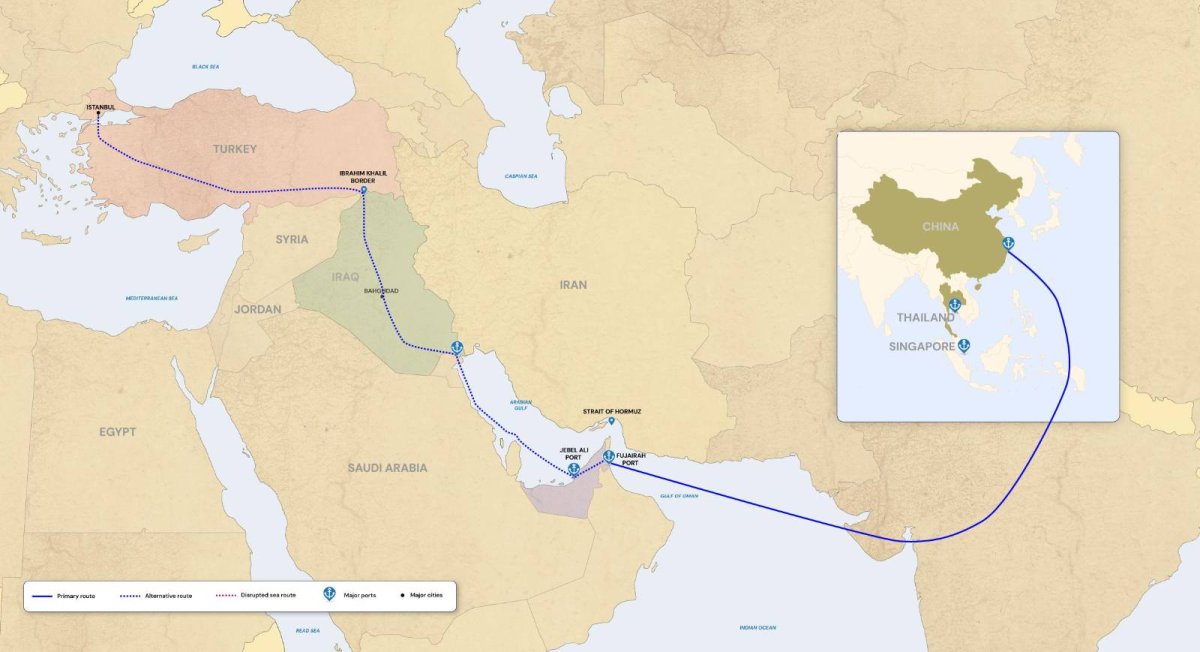
Map of the Gulf with arrows pointing through the strait and beyond
One of the reasons traders have singled out Iraq, and not the UAE, is due to the UAE presenting alternative options to the Jebel Ali port that promises to bypass the Strait. As shown in the map above, the Khorfakkan port offers access from the Indian Ocean, directly into the UAE, with its recently built Etihad Rail connecting Fujairah to the UAE’s major cities and ports. However, this is currently proving to be an underdeveloped option. As one trader explained to me, “when they closed the Strait, I already had a container on its way from China to here [Jebel Ali].
We decided to have it rerouted to Khorfakkan and then had our cargo transported by truck to Jebel Ali. This little reroute alone cost us 7, 8 thousand dollars, without considering the original cost of shipping from China which was 2 thousand dollars.”18
The closure of the Strait of Hormuz, as expected, forced a rerouting of maritime traffic. However, as this presented an opportunity for the UAE to shift its central maritime port from Jebel Ali to Khorfakkan, there is still work that needs to be done to advance its infrastructure at the pace this ambition requires. The Fujairah Oil Industry Zone (FOIZ) was established in 2011 as a strategic bet on exactly this scenario, designed to position the emirate as the heart of a new energy corridor stretching from east of the Suez Canal to Asia.19 However, moving goods from Khorfakkan to Jebel Ali, and then onward to Iraq, requires overland transport across a mountainous landscape that was never designed for the volume of traffic Jebel Ali processes daily. This infrastructure gap is not new, but the war has accelerated and magnified the problem and changes it may cause to the market.
This has resulted in a significant cost increase. Transporting goods from Fujairah to Jebel Ali, then onward to Iraq, adds thousands of dollars per container. One trader suggested this was both the nature of an additional step in the shipment course, and the hiked wartime prices of fuel and transport. However, he stressed that “the prices will never go down to what it was, but if it would at least go down to something more reasonable, we could convince our customers to bear some of the additional cost.”20 The cost of fuel may be projected to return to some form of normalcy with the opening of the Strait, or with the UAE being able to shift its dependence to Fujairah and having withdrawn from OPEC.
Notably, this leaves the infrastructure gap of routing goods from Khorfakkan to Jebel Ali and onwards to Iraq to maintain this Iraq-UAE connection, and with the opening of the Etihad Rail, this appears to be a short-term issue. However, Fujairah, a mountainous and – comparatively to other Emirates – underdeveloped region, requires more efficient and potentially large-scale logistics zones such as those that define Jebel Ali. The UAE appears to be aware of this as one stakeholder explained to me, but its main concern is maintaining the oil economy through Fujairah. As the website boasts, the capacity of the FOIZ is in the region of 70 million barrels, making it the Middle East’s largest commercial storage capacity for refined oil products. However, there is a window that the Iraq-UAE market is now operating within, wherein if traders begin cementing their shift towards Türkiye, and Türkiye in turn captures this market share, especially if credit relationships reorient in this direction perpetuating trade relationships, Iraq-UAE may struggle to bounce back within these sectors.
The policy question becomes whether, as the UAE appears to be doing, Iraq can accelerate infrastructure solutions to preserve these trade relationships before they shift. Speaking to business owners and stakeholders in the UAE, it became clear that while the Khorfakkan port offers limited solutions, it is perhaps a problem the UAE does not recognize as urgently as Iraq may. That is, it is already understood that currently Khorfakkan's port cannot, by way of infrastructure or size, offer what the Jebel Ali Free Zone (JAFZA) and port offers. This has created an understanding within Iraq-UAE business relations that no matter the current harm to trade routes, trade will inevitably return to JAFZA, and what is perhaps offered elsewhere in terms of routes through Bab al-Mandab remain short-term solutions for traders. As it stands the Fujairah port is being rebuilt and expanded to be able to take on some of JAFZA’s traffic, but it faces hurdles and a long path to reaching the size and structure of Jebel Ali.
Some may argue that the Etihad Rail, the UAE’s new rail system that operates from Fujairah in the East to the UAE’s western border, passing through major cities, including Dubai, offers a solution. However, in my conversations with stakeholders, it was clear this was not one of the major concerns of the nation’s economic infrastructure. Stakeholders continuously insisted that there will be an inevitable return to Jebel Ali “once things go back to normal”, citing the port’s size and advanced infrastructure as too large to fail. Even when I pushed him to consider the shift of Iraqi traders to Türkiye for their materials, he dismissed the concern. He argued that these secondary markets would come back regardless, and that even if they did not, their influence on the UAE's market was minimal. He acknowledged that Jebel Ali makes money both from traders that bring materials and sell them at the port, and from serving as a passage point into Basra.
If Türkiye was genuinely cheaper and better, traders would have shifted their businesses there even before the war.
But he maintained that if Türkiye was genuinely cheaper and better, traders would have shifted their businesses there even before the war. He further brushed off the secondary market that JAFZA had offered Iraqi traders, whereby imports from East Asia would either use Jebel Ali as a stop on the way to Basra, or be sold from East Asia to traders in Dubai who would then sell their materials onwards to Iraq, generating various customs revenues for the UAE. Traders’ short-term issue remains cost and logistics. As traders look towards Türkiye, bypassing the closure of the Strait, the question is whether infrastructure development at Fujairah (or the reopening of the Strait) can stabilize the route or whether Iraq's supply chains will reorient northward, with lasting consequences for both Iraq-Asia and Iraq-GCC economic integration.
Faced with seemingly unviable Gulf routes, as well as growing distrust with the Iraqi market, traders explained where their more long-term solutions lay. Türkiye appeared to be the constant solution to both the issue of trade reroutes and supply disruptions, particularly when looking at construction materials. One trader explained this to me in detail, that the decision to look to Türkiye as either the route or the supplier itself is based on a complex reading of the Iraqi market:
“First of all, I cannot rely on the Chinese or Thai market anymore when the Strait stays closed. And if construction starts up again, I think the transport companies are going to look to either bring things through Bab al-Mandab, through Türkiye, I don't know some way like that. It might cost more but it will at least be reasonable. Or, the other solution, is I start to bring my materials [pipes and fittings] from Türkiye. You cannot bring these materials from Saudi, even though they have factories themselves, they make these materials too high-end, like the Europeans. The Iraqi market will not accept that, they want something in between cheap and reasonable. I cannot sell these Gulf products on the Iraqi market, so the solution is Türkiye. They have the right materials, it’s a little more expensive than China and Thailand, but it's there, and it has easy access to Iraq. The route is already there and ready.”21
With much to unpack here, I asked this trader what the situation would be should the rise in transport prices make Gulf products price-competitive. The answer remained similar, where he insisted that these products are not desired in Iraq. He continuously insisted on brand recognition, wherein Gulf products, whether in reality or perceptually, are considered too high-end for the needs of the Iraqi market. This suggests that there is movement occurring within the Iraqi-GCC market that may not recover from the war and Strait closure. The compounding reasons are pushing traders westward, into what is considered a less contested, and more predictable route.
Ultimately, while the GCC’s concerns lie elsewhere, traders on the ground are reorienting their flows away from the Gulf. This matters because these grassroots trade ties have historically tightened Iraq-GCC integration. If Baghdad allows this shift to continue unchecked, it risks undermining its strategic objective since the late 2010s, that is, to reorient Iraq's economic dependence away from Iran.22 That strategy was always about encouraging Iraq-Gulf engagement, that promised GCC businesses the ability to operate without becoming entangled in Iraq’s complex internal politics, steadily building ties that outlast any single administration or political situation in Baghdad.
Policy Recommendations and Conclusion
The closure of the Strait of Hormuz has exposed a quiet crisis in Iraq-Gulf economic integration, one that extends beyond oil exports and food security headlines. The traders who move manufacturing inputs through the UAE to Iraq are being priced out of a route they once relied upon for its predictability and cost stability. These overlooked sectors lack the scale to absorb massive shipping cost increases, and their erosion represents a meaningful but underappreciated consequence of the war. Some have already begun redirecting their supply chains toward Türkiye, drawn by product suitability and the promise of a less contested route. What makes this shift significant is its direction, as trade relationships built on credit and trust among smaller traders do not reorient easily, and once they do, they take time to be pulled back.
These traders operate beneath the level of formal agreements but can be the foundation upon which longer term economic alignment takes root. If Baghdad and its Gulf partners allow this reorientation to unfold without intervention, they risk undercutting a strategic objective that has driven Iraq-GCC engagement since the late 2010s. For the newly formed government of Prime Minister Ali al-Zaidi, the erosion of these routes presents a practical obstacle to maintaining the informal foundation of Iraq-GCC integration. Al-Zaidi's past as a businessman will perhaps lead him to recognize that high-level memoranda of understanding do not solve the problems of traders on the ground. Baghdad should establish direct engagement with chambers of commerce, traders' associations, and transport companies to understand where the real friction points lie.
The Iraqi government could also consider targeted support for low-value sectors, including temporary tariff reductions, expedited customs clearance, or subsidized freight costs for containers moving from Fujairah to Iraqi border crossings. Rather than permanent subsidies, the goal would be a bridge until infrastructure solutions mature or the crisis of the Strait is resolved. Al-Zaidi's administration must also act on information asymmetry. In partnership with the GCC General Secretariat, Baghdad could establish a publicly accessible dashboard tracking container freight costs, transit times, and route viability from Khorfakkan, Jebel Ali, and Turkish ports to Iraqi border crossings. Traders currently operate with limited visibility into alternative routes, and better data could limit fears that are perhaps outdated.
For wider GCC stakeholders, the preservation of Iraq-GCC trade routes should be treated as a strategic priority, not solely a commercial one. The nearly decade-long effort Gulf states have spent trying to pull Iraq's economic center of gravity closer to themselves was about steadily weaving ties that could outlast any single administration or political crisis in Baghdad. The closure of the Strait threatens to undo this work at the most basic level of trade. If Iraqi traders permanently reorient their supply chains toward Türkiye, the Gulf loses both a trade route and an opportunity to engage with Iraq's economic alignment at a moment when that alignment is being contested by the regional war.
This would mean directly engaging with the Iraqi government on infrastructure solutions, supporting data transparency initiatives, and recognizing that low-value sectors, while less glamorous than energy or defense, are the foundation upon which longer term economic integration is built within Iraq's complex political sphere. The window to act, however, is narrowing quickly. Every container rerouted through Türkiye, credit relationship that shifts northward, and trader who decides that Iraq is no longer worth the hassle makes the return to a Gulf-oriented trade corridor harder to reverse. If Iraqi and Gulf policymakers want Iraq to remain within the Gulf's economic orbit, they cannot afford to wait for normalcy to return.
This article will be included in the fourteenth edition of the Iraq Economic Review.
Faced with seemingly unviable Gulf routes, as well as growing distrust with the Iraqi market, traders explained where their more long-term solutions lay. Türkiye appeared to be the constant solution to both the issue of trade reroutes and supply disruptions, particularly when looking at construction materials. One trader explained this to me in detail, that the decision to look to Türkiye as either the route or the supplier itself is based on a complex reading of the Iraqi market:
“First of all, I cannot rely on the Chinese or Thai market anymore when the Strait stays closed. And if construction starts up again, I think the transport companies are going to look to either bring things through Bab al-Mandab, through Türkiye, I don't know some way like that. It might cost more but it will at least be reasonable. Or, the other solution, is I start to bring my materials [pipes and fittings] from Türkiye. You cannot bring these materials from Saudi, even though they have factories themselves, they make these materials too high-end, like the Europeans. The Iraqi market will not accept that, they want something in between cheap and reasonable. I cannot sell these Gulf products on the Iraqi market, so the solution is Türkiye. They have the right materials, it’s a little more expensive than China and Thailand, but it's there, and it has easy access to Iraq. The route is already there and ready.”21
With much to unpack here, I asked this trader what the situation would be should the rise in transport prices make Gulf products price-competitive. The answer remained similar, where he insisted that these products are not desired in Iraq. He continuously insisted on brand recognition, wherein Gulf products, whether in reality or perceptually, are considered too high-end for the needs of the Iraqi market. This suggests that there is movement occurring within the Iraqi-GCC market that may not recover from the war and Strait closure. The compounding reasons are pushing traders westward, into what is considered a less contested, and more predictable route.
Ultimately, while the GCC’s concerns lie elsewhere, traders on the ground are reorienting their flows away from the Gulf. This matters because these grassroots trade ties have historically tightened Iraq-GCC integration. If Baghdad allows this shift to continue unchecked, it risks undermining its strategic objective since the late 2010s, that is, to reorient Iraq's economic dependence away from Iran.22 That strategy was always about encouraging Iraq-Gulf engagement, that promised GCC businesses the ability to operate without becoming entangled in Iraq’s complex internal politics, steadily building ties that outlast any single administration or political situation in Baghdad.
Policy Recommendations and Conclusion
The closure of the Strait of Hormuz has exposed a quiet crisis in Iraq-Gulf economic integration, one that extends beyond oil exports and food security headlines. The traders who move manufacturing inputs through the UAE to Iraq are being priced out of a route they once relied upon for its predictability and cost stability. These overlooked sectors lack the scale to absorb massive shipping cost increases, and their erosion represents a meaningful but underappreciated consequence of the war. Some have already begun redirecting their supply chains toward Türkiye, drawn by product suitability and the promise of a less contested route. What makes this shift significant is its direction, as trade relationships built on credit and trust among smaller traders do not reorient easily, and once they do, they take time to be pulled back.
These traders operate beneath the level of formal agreements but can be the foundation upon which longer term economic alignment takes root. If Baghdad and its Gulf partners allow this reorientation to unfold without intervention, they risk undercutting a strategic objective that has driven Iraq-GCC engagement since the late 2010s. For the newly formed government of Prime Minister Ali al-Zaidi, the erosion of these routes presents a practical obstacle to maintaining the informal foundation of Iraq-GCC integration. Al-Zaidi's past as a businessman will perhaps lead him to recognize that high-level memoranda of understanding do not solve the problems of traders on the ground. Baghdad should establish direct engagement with chambers of commerce, traders' associations, and transport companies to understand where the real friction points lie.
The Iraqi government could also consider targeted support for low-value sectors, including temporary tariff reductions, expedited customs clearance, or subsidized freight costs for containers moving from Fujairah to Iraqi border crossings. Rather than permanent subsidies, the goal would be a bridge until infrastructure solutions mature or the crisis of the Strait is resolved. Al-Zaidi's administration must also act on information asymmetry. In partnership with the GCC General Secretariat, Baghdad could establish a publicly accessible dashboard tracking container freight costs, transit times, and route viability from Khorfakkan, Jebel Ali, and Turkish ports to Iraqi border crossings. Traders currently operate with limited visibility into alternative routes, and better data could limit fears that are perhaps outdated.
For wider GCC stakeholders, the preservation of Iraq-GCC trade routes should be treated as a strategic priority, not solely a commercial one. The nearly decade-long effort Gulf states have spent trying to pull Iraq's economic center of gravity closer to themselves was about steadily weaving ties that could outlast any single administration or political crisis in Baghdad. The closure of the Strait threatens to undo this work at the most basic level of trade. If Iraqi traders permanently reorient their supply chains toward Türkiye, the Gulf loses both a trade route and an opportunity to engage with Iraq's economic alignment at a moment when that alignment is being contested by the regional war.
This would mean directly engaging with the Iraqi government on infrastructure solutions, supporting data transparency initiatives, and recognizing that low-value sectors, while less glamorous than energy or defense, are the foundation upon which longer term economic integration is built within Iraq's complex political sphere. The window to act, however, is narrowing quickly. Every container rerouted through Türkiye, credit relationship that shifts northward, and trader who decides that Iraq is no longer worth the hassle makes the return to a Gulf-oriented trade corridor harder to reverse. If Iraqi and Gulf policymakers want Iraq to remain within the Gulf's economic orbit, they cannot afford to wait for normalcy to return.
Endnotes
1. Yerevan Saeed, ‘Iraq Deepens Ties With GCC Neighbors’, Arab Gulf States Institute, 2023, https://agsi.org/analysis/iraq-deepens-ties-with-gcc-neighbors/.
2. This model includes a 2019 MoU signed between the GCC General Secretariat and the Iraqi Ministry of Foreign Affairs, to enhance integrated economic and security development; see Naza Mohamed, "Iraq, GCC Sign MoU for Enhanced Cooperation," Anadolu Agency, 2019, https://www.aa.com.tr/en/middle-east/iraq-gcc-sign-mou-for-enhanced-cooperation/1461918. The 2018 Iraq Conference hosted by Kuwait with $30 billion committed to aid in rebuilding Iraq; see Deutsche Welle, "Kuwait Summit: $30 Billion to Rebuild Iraq," Deutsche Welle, 2018, https://www.dw.com/en/kuwait-summit-promises-30-billion-in-iraq-reconstruction-aid/a-42586658. Saudi Arabia and the UAE’s 2021 commitment to furthering their investment in Iraq by $3 billion; see Mina Aldroubi, "Iraq’s Plan to Diversify Regional Trade Relations Aims to Fend Off Iran’s Influence," The National, 2021, https://www.thenationalnews.com/mena/iraq/iraq-s-plan-to-diversify-regional-trade-relations-aims-to-fend-off-iran-s-influence-1.1197721. Qatar’s Foreign Minister’s visit in 2021 to Baghdad to initiate a joint committee to enhance the economic integration between the two countries; see The Arab Weekly, "Qatar Leverages Gulf Reconciliation, Iran Ties in a Race for Influence in Iraq," 2021, https://thearabweekly.com/qatar-leverages-gulf-reconciliation-iran-ties-race-influence-iraq. Currently, Iraq-GCC relations are being shaped by Iraqi-Kuwaiti tensions over the Khor Abdullah waterway dispute; see Rami Alkhafaji and Safwan Al-Amin, "Can Iraq and Kuwait Transform the Khor Abdullah Waterway Dispute into a Regional Diplomacy Model?," Atlantic Council, 2025, atlanticcouncil.org—despite assumed improvements in relations with the ending of Iraq’s payment obligations after the invasion of Kuwait in 2022; see Taha Alani, "Ma Igh'laq Malaf al-Ta'weeth... Ma Shekl al-'Ilaq'a Wa Mu'heet'hu al-Khaleeji? [With the Compensation File Closed... What Will the Relationship Between Iraq and Its Gulf Neighbors Look Like?]," Al Khaleej, 2022, alkhaleejonline.net. Finally, evolutions in Saudi Arabian regional diplomacy towards Iran through Iraq; see Zeidon Alkinani, "Current Iraq-Gulf Relations: Economics over Politics?," Arab Center Washington DC, 2022, https://arabcenterdc.org/resource/current-iraq-gulf-relations-economics-over-politics/; and Qatar’s shift to pragmatism and wider regional relations since the Gulf 2017 blockade against it, see Nussaibah Younis, "The Gulf between Them: What Arab Gulf Countries Can Learn from Iran’s Approach to Iraq," European Council on Foreign Relations, 2021, https://ecfr.eu/publication/the-gulf-between-them-what-gulf-countries-can-learn-from-irans-approach-to-iraq/#_ftn7.
3. Susan M. Akram et al., The US-Israel War on Iran: Analyses and Perspectives (Arab Center Washington DC, 2026), https://arabcenterdc.org/resource/the-us-israel-war-on-iran-analyses-and-perspectives/.
4. Kuwaiti oil output has dropped by roughly 53% while the UAE’s output has dropped by 44% over the course of the war, see Spencer Kimball, ‘Middle East Oil Production Plunges Due to Iran War, OPEC Data Shows’, CNBC News, 2026, https://www.cnbc.com/2026/04/13/iran-war-oil-opec-production-decline.html. Separate routes such as Saudi’s East-West Pipeline had been hit during the war, see Summer Said, ‘Saudi Pipeline for Crude Exports Hit in Drone Attack’, The Wall Street Journal, 2026, https://www.wsj.com/livecoverage/iran-war-2026-trump-deadline-latest-news/card/saudi-arabian-pipeline-for-crude-exports-hit-in-drone-attack-XElDwcHsniRl6xfUOi8s. Iraq has opted to export oil overland through Syria, but struggles to maintain the same load of exports typically done by sea (amounting to 20%, see Bridget Toomey, Iraq Is Envisioning New Oil Pipelines — But They Are Likely a Pipe Dream (Foundation for Defense of Democracies, 2026), https://www.fdd.org/analysis/2026/05/05/iraq-is-envisioning-new-oil-pipelines-but-they-are-likely-a-pipe-dream/). This has spelled important developments, such as the UAE’s withdrawal from OPEC, see Maha El Dahan, ‘UAE Leaves OPEC in Blow to Global Oil Producers’ Group’, Reuters, 2026, https://www.reuters.com/markets/commodities/uae-says-it-quits-opec-opec-statement-2026-04-28/.
5. The oil industry overshadowed notable significant changes to other sectors that perhaps are incapable of warranting the same attention. For example, there have been detrimental effects on food security as Iran and the GCC, particularly Saudi Arabia, Qatar, Oman have accounted for nearly 30-35 % of global fertilizer production, see Food And Agriculture Organization, Global Agrifood Implications of the 2026 Conflict in the Middle East (United Nations, 2026), https://openknowledge.fao.org/server/api/core/bitstreams/1aafb5d8-39d1-481a-b1f8-25facaec3051/content. Unlike the oil sector, there are limited internationally coordinated initiatives to solve this problem, see Nayef Al-Nabet, Maritime Chokepoints & the Changing Logic of Conflict in the Gulf (Fiker Institute, 2026), https://www.fikerinstitute.org/publications/maritime-chokepoints-the-changing-logic-of-conflict-in-the-gulf.
6. Bassem Mroue et al., ‘US and Iran Agree to 2-Week Ceasefire as Trump Pulls Back on Threats’, AP News, 2026, https://apnews.com/article/iran-us-israel-trump-lebanon-april-7-2026-421ee64fdc9a5c26460df8119c7d1b3f.
7. Muhanad Saloom, Iraq’s Gulf Pivot and the Cost of Inaction (Gulf International Forum, 2023), https://gulfif.org/iraqs-gulf-pivot-and-the-cost-of-inaction/.
8. Arabian Post, ‘UAE Seeks Broader Cooperation with Iraq’, The Arabian Post, 2024, https://thearabianpost.com/uae-seeks-broader-cooperation-with-iraq/.
9. Shweta Jain, ‘UAE Signs Deal with Iraq to Protect and Promote Investments’, The National News, 2021, https://www.thenationalnews.com/business/2021/10/19/uae-signs-deal-with-iraq-to-protect-and-promote-investments/.
10. Al Jazeera, ‘Syria’s Assad Visits UAE in First Trip to Arab State since 2011’, Al Jazeera, 2022, https://www.aljazeera.com/news/2022/3/18/syrias-assad-visits-uae-in-first-trip-to-arab-state-since-2011.
11. Jain, ‘UAE Signs Deal with Iraq to Protect and Promote Investments’.
12. Toby Dodge and Renad Mansour, Politically Sanctioned Corruption and Barriers to Reform in Iraq, Middle East and North Africa Programme (Chatham House, 2021).
13. Jay Hilotin, ‘Oil Shock 2.0? Houthis Threaten Bab Al-Mandab Shutdown as Hormuz Drama Reignites, Crude Prices Rebound’, Gulf News, 2026, https://gulfnews.com/world/mena/oil-shock-20-houthis-threaten-bab-al-mandab-shutdown-as-hormuz-drama-reignites-crude-prices-rebound-1.500513103.
14. Interview with author, 2026.
15. Interview with author, 2026.
16. Interview with author, 2026.
17. Interview with author, 2026.
18. Interview with author, 2026.
19. Fujairah Oil Industry Zone, accessed July 6, 2026, foiz.gov.ae.
20. Interview with author, 2026.
21. Interview with author, 2026.
22. Abbas Kadhim, ‘The Geopolitical Imperative of Iraq-GCC Relations’, Arab Gulf States Institute, 2026, https://agsi.org/analysis/the-geopolitical-imperative-of-iraq-gcc-relations/; Ashraf Moammed Kishk, ‘Iraq and the Security Situation in the Gulf Region: Advantage or Threat?’, in GCC Relations with Post-War Iraq: A Strategic Perspective, ed. Omar Al-Ubaydli and Andrea Plebani (Gulf Research Center, 2014), 54.

